
 +965 2224 8361


Daily Economic Update
30.03.2026
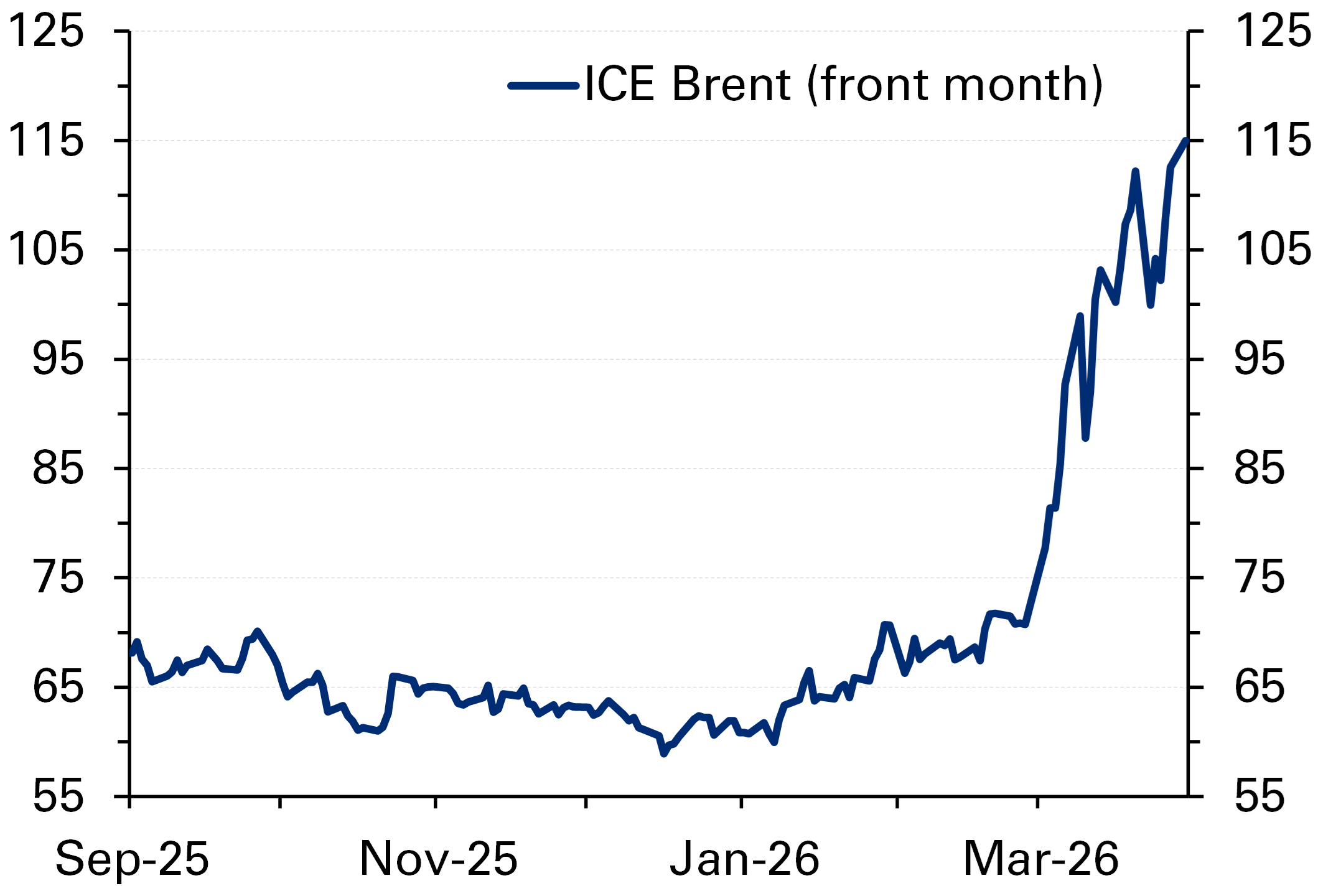
Oil: Prices rise after Yemen's Houthis join conflict; Brent poised for record monthly gain. Brent futures opened 2.2% higher in early Asian trading today at $115/bbl, reacting to Yemen's Ansarallah launching their first attacks at Israel over the weekend and as more US troops arrived in the region, both of which signal a widening and intensification of the conflict. Adding to jitters was President Trump's hawkish statement overnight that he wants to "take the oil in Iran", implying potential seizure of Iran’s oil facilities on Kharg island. Since the onset of the conflict in late February, global markets have experienced one of the most severe disruptions on record, with Brent futures on track for a record monthly gain of 59% as flows through the Strait of Hormuz have all but ceased. Overall oil maritime trade from the region – covering both crude oil and refined products – is estimated to have fallen from pre-conflict levels by roughly 40% to around 12 mb/d. Meanwhile, our estimates suggest that at least 8 mb/d of crude production has been taken offline across the region, as storage constraints and export bottlenecks have forced widespread shut-ins. In response to the scale of the disruption, the International Energy Agency announced the largest coordinated release of strategic petroleum reserves in its history, underscoring the severity of the supply shock. However, the impact has been tempered by the time required for barrels to physically reach the market, as well as the fact that the implied flow from the release (~1.5–2 mb/d) will only offset a portion of the lost supply. The disruption has also spilled into refined product markets, with jet fuel emerging as the tightest segment. Europe, which typically imports 20–30% of its aviation fuel from the Gulf, has experienced a sharp loss of supply and significant price dislocations. At the same time, the crisis has extended beyond oil, with QatarEnergy declaring force majeure on LNG exports (around 7% of global supply), compounding the broader energy shock. The closure of the Strait has also triggered a global fertilizer disruption, with roughly a third of seaborne trade affected, while aluminum markets have tightened significantly, given the region’s ~8% share of global supply. Taken together, the scale and breadth of the disruption – spanning crude, products, gas, and other commodities – highlight the systemic nature of the shock, with both physical supply losses and logistical constraints driving sustained upward pressure on prices despite ongoing policy intervention.
Global: Financial markets’ rout extends on the Middle East conflict; a further steep fall adds pressure on Trump to end the war. Amid the ongoing Middle East war, a resulting surge in energy prices, trade disruptions, and scarcity in many other goods – such as fertilizers and refined petroleum products – have greatly rekindled global inflation and growth worries. Consequently, global financial markets have reeled, with equity markets witnessing sharp drawdowns and benchmark yields climbing to multi-year highs across many developed markets. The S&P 500 is down by over 7% since the war began, hovering at its lowest level since August 2025, the Nasdaq Composite entered correction territory, the Euro Stoxx 50 by over 10%, the FTSE 100 by around 9% and the Nikkei 250 by around 9% (and down by more than 3% intraday at the time of writing). Similarly, along with inflationary headwinds, pressure on government fiscal metrics have driven yields on 10Y government bonds steeply higher since the war started, with those on UST up nearly 50 bps (to the highest closing level since July 2025), by over 45 bps on German bunds (the highest closing level since 2011), by over 60 bps for French bonds (the highest closing level since 2009), by around 70 bps for UK gilts (the highest closing level since 2008) and by around 25 bps for Japanese government bonds (nearly 30-year high). If the downturn in the US equity and bond markets deepens sharply from here along with a further increase in oil prices, that is going to put additional pressure on President Trump to find a way to end the war.
Global: All eyes on the Middle East war developments; US March jobs report and Eurozone March inflation key data points this week. The Middle East war, in its fifth week now, continues to dictate market moves and drive wider implications for the global economy and inflation. In the US, Fed Chair Powell will speak later today and may provide additional insights into the Fed’s thinking given the current upward pressure on inflation due to higher energy prices and other supply chain disruptions. Several other Fed officials will also be speaking this week. In terms of the economic data, March’s non-farm payrolls (on Friday) are expected to rebound by 48K following February’s fall of 92K, with the unemployment rate seen ticking up to 4.5% from 4.4%. Retail sales in February (Wednesday) are seen rebounding by 0.4% m/m after a drop of 0.2% in January. Finally, the ISM manufacturing PMI (Wednesday) is expected at 52.3 in March, just slightly below February’s 52.4. In the Eurozone, flash inflation data for March is due on Tuesday, with the headline rate expected to accelerate to 2.8% y/y from 1.9% in February on the back of higher energy prices. In the UK, the Nationwide house price index (Tuesday) is seen rising by 0.6% m/m after an increase of 0.3% in February. In China, the official NBS PMIs for March are due on Tuesday with the manufacturing and non-manufacturing gauges expected at 50.0 and 49.9, respectively, a slight improvement from February’s levels. Finally in Japan, the street forecasts February’s industrial production to decline by 2.1% m/m following a 4.3% increase in January while growth in retail sales is seen slowing to 0.8% y/y in February from 1.8% in January; both are due on Tuesday.